MathPro
Adaptive Assessment Strategy Framework
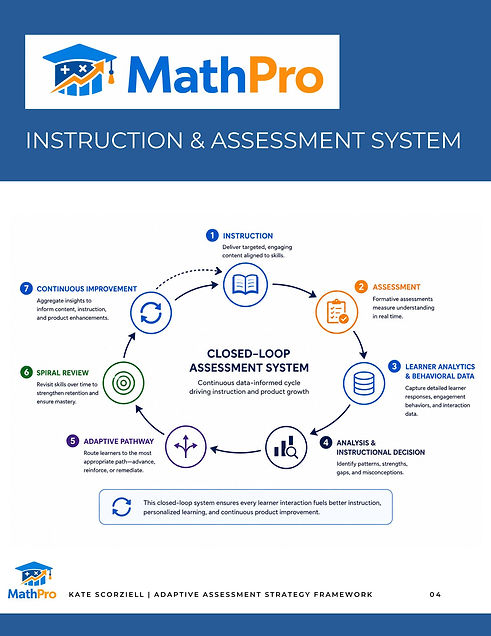
Designing the assessment framework necessary to build a scalable adaptive learning product that uses assessment, learner analytics, and behavioral data to drive instructional decisions and continuous product improvement.
Role:
Instructional Systems Designer
Timeline:
October, 2025 - June 2026
Focus:
-
Adaptive Learning
-
Assessment Architecture
-
Behavioral Analytics
-
Learning Analytics
-
Product Strategy

Transforming assessment into a self-improving instructional system driven by adaptive learning, behavioral analytics, and continuous feedback.
Project Overview
MathPro’s Adaptive Assessment Strategy System was designed as a scalable framework for personalized learning within an asynchronous EdTech environment. Instead of treating assessment as a separate evaluation tool, this project explored how assessment systems can function as the core instructional engine of a product, continuously guiding learner progression, instructional adaptation, and long-term product improvement through real-time learner data.
The system integrated diagnostic, formative, and summative assessments into a unified adaptive learning architecture capable of making instructional decisions without live instructor intervention. Learner performance data, engagement patterns, response consistency, time-on-task, misconception trends, and behavioral indicators were all used to inform progression, remediation, reinforcement, pacing adjustments, and adaptive pathway placement. A major focus of the project was designing systems that could generate actionable learner analytics while minimizing unnecessary cognitive load and maintaining engagement over time.
What makes this project unique is its combination of instructional systems design, adaptive learning architecture, behavioral analytics, and product-oriented decision-making within a single operational framework. Rather than focusing only on measuring learning outcomes, the project explored how assessment systems themselves can become self-improving feedback infrastructures that continuously refine instruction, improve learner experience, and support scalable product growth over time.
Adaptive Assessment Strategy Framework
Designing a scalable adaptive learning ecosystem where diagnostic, formative, and summative assessments work together with learner analytics, behavioral engagement data, and adaptive pathway logic to guide personalized instruction, real-time intervention, mastery progression, and continuous product improvement.
Page 4

Design Process
Key Design Points & Considerations
Beginning the Process
The development MathPro's Assessment Framework began with identifying the instructional, operational, and engagement challenges associated with building a scalable asynchronous learning platform.
Early planning focused on balancing assessment precision, learner engagement, adaptive personalization, and long-term scalability within a self-improving learning ecosystem.
Research & Systems Planning
Key Design Priorities
Assessment Precision
Ensure diagnostic, formative, and summative assessments produced reliable instructional decisions.
Action:
Integrated multi-layered assessment systems with mastery thresholds, reassessment logic, misconception analysis, and performance validation processes to support reliable instructional and progression decisions.
Adaptive Personalization
Design systems capable of adjusting instruction based on learner performance and behavioral data.
Action:
Designed diagnostic, formative, and summative assessment systems that continuously informed adaptive pathway placement, remediation, reinforcement, and learner progression based on both performance and behavioral engagement data.
Learner Engagement
Reduce cognitive overload and instructional friction within asynchronous learning pathways.
Action:
Incorporated behavioral analytics such as time-on-task, drop-off patterns, repeated attempts, and scaffold dependency to identify instructional friction, reduce cognitive overload, and improve long-term learner persistence.
Scalable Systems Design
Create operational frameworks capable of supporting long-term product growth and continuous improvement.
Action:
Developed interconnected assessment, analytics, and instructional decision-making frameworks capable of supporting continuous improvement, operational consistency, and personalized learning across a growing asynchronous EdTech environment.

Learner Engagement Considerations
A major design consideration involved balancing assessment precision with learner engagement. While continuous assessment improves adaptive decision-making, excessive evaluation can increase cognitive overload and disengagement. The framework therefore prioritized low-friction formative assessment, behavioral analytics, and targeted mastery checks to support both instructional accuracy and learner persistence.
Page 6
Addressing Engagement Considerations
To reduce cognitive overload and disengagement while maintaining assessment precision, the framework incorporated low-friction formative assessments, embedded mastery checks, adaptive pathway progression, reassessment logic, and behavioral analytics such as time-on-task, drop-off patterns, and repeated attempts. These systems allowed the platform to gather actionable learner data continuously without relying on excessive high-stakes assessment events.
Adaptive Assessment Design
The assessment framework was designed as an interconnected adaptive learning system integrating diagnostic, formative, and summative assessments with learner analytics, behavioral engagement data, and adaptive pathway logic.
Each assessment layer was intentionally designed to support instructional decision-making, personalized progression, real-time intervention, and long-term learning validation within a scalable asynchronous learning environment.

Formative, Summative, & Diagnostic Assessments
The adaptive assessment system architecture was designed as an interconnected instructional framework integrating diagnostic, formative, and summative assessments with learner analytics, behavioral engagement data, and adaptive pathway logic.
Each assessment layer serves a distinct instructional purpose while continuously contributing to personalized progression, real-time intervention, mastery validation, and long-term instructional refinement within a scalable asynchronous learning environment.
Page 14
Adaptive Pathways


Page 14
Page 10
Page 12
The adaptive pathway logic was designed to automatically adjust learner progression, remediation, reinforcement, and pacing decisions based on assessment performance, mastery thresholds, behavioral engagement signals, and misconception analysis.
By continuously interpreting learner data in real time, the system supports scalable personalized learning while reducing unnecessary friction and improving instructional precision across the adaptive learning experience.